
SoFi Stadium: World Cup 2026 LA Venue — Match Schedule, Data & Facts
 Available in US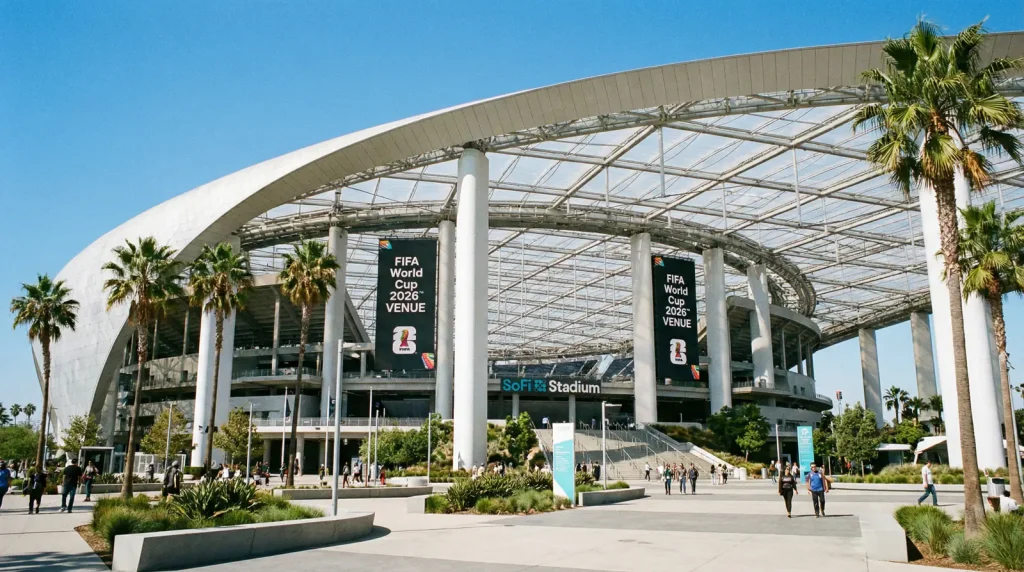
Table of Contents
Five billion dollars bought something genuinely unprecedented in stadium architecture. SoFi Stadium’s translucent ETFE canopy creates an enclosed environment without fully sealing the space — ventilation flows through while weather protection shields spectators from southern California’s sun. Having analysed venue data across two decades of international tournaments, I’ve never encountered a stadium quite like SoFi: simultaneously open-air for FIFA’s regulatory purposes and climate-controlled enough to maintain consistent playing conditions regardless of exterior weather.
The 2026 World Cup marks SoFi’s first major football tournament, though the venue has already hosted Super Bowl LVI and will stage the 2028 Olympics opening ceremony. Los Angeles represents the United States’ largest metropolitan football market, with MLS club LAFC, Liga MX’s cross-border popularity, and a Latino community deeply connected to South American and Central American national teams. SoFi’s World Cup matches will play to packed houses regardless of which nations are involved.
Technical Specifications and Design Data
SoFi Stadium’s US$5.5 billion price tag makes it the most expensive stadium ever constructed — anywhere, for any sport. The cost includes not just the venue itself but the surrounding Hollywood Park entertainment complex, a 298-acre development that transforms the Inglewood area into a destination precinct. For World Cup purposes, the stadium specifications matter more than the surrounding development.
| Specification | Data |
|---|---|
| Capacity (Football Config) | 78,000 |
| Total Construction Cost | US$5.5 billion |
| Opened | 2020 |
| Roof Type | ETFE canopy (open-air classification) |
| Playing Surface (WC 2026) | Natural grass (modular system) |
| Pitch Dimensions | 105m × 68m (FIFA standard) |
| Elevation | 30 metres above sea level |
| Video Board | 109m × 12m (largest in sports) |
The ETFE (ethylene tetrafluoroethylene) canopy deserves particular attention. This translucent polymer allows natural light through while blocking direct sun exposure, creating a luminous interior that photographs dramatically for broadcast purposes. The canopy covers both the seating bowl and the playing surface without fully enclosing the space, satisfying FIFA’s preference for open-air venues while providing practical weather protection.
The Infinity Screen video board measures 109 metres long — longer than a football pitch — and wraps around the stadium’s interior. From a broadcast perspective, this creates replay capabilities unmatched at any other World Cup venue. For spectators, every seat offers clear views of multiple screen sections, ensuring no one misses critical moments regardless of their viewing angle.
SoFi’s sunken bowl design places the playing surface approximately 30 metres below street level, protecting the field from wind exposure that affects many open-air stadiums. This engineering choice creates calm conditions regardless of exterior weather patterns, benefiting technical play and accurate crossing — factors that affect betting markets around playing styles.
World Cup 2026 Match Schedule
FIFA allocated seven matches to SoFi Stadium, including group stage fixtures, Round of 16 elimination matches, and a Semi-Final — one of only two venues hosting World Cup semi-finals alongside MetLife Stadium. The schedule reflects SoFi’s status as the tournament’s western anchor, complementing East Coast venues with Pacific Time zone coverage.
| Date | Round | Match | Kick-off (ET) | Kick-off (AEST) |
|---|---|---|---|---|
| Friday, 13 June | Group J | Argentina vs Algeria | 15:00 | 05:00 Sat 14 June |
| Sunday, 15 June | Group G | Belgium vs Iran | 13:00 | 03:00 Mon 16 June |
| Thursday, 19 June | Group G | Iran vs New Zealand | 21:00 | 11:00 Fri 20 June |
| Tuesday, 24 June | Group J | Argentina vs Austria | 21:00 | 11:00 Wed 25 June |
| Wednesday, 2 July | Round of 16 | Match 54 (1B vs 3A/C/D) | 14:00 | 04:00 Thu 3 July |
| Thursday, 3 July | Round of 16 | Match 56 (2D vs 2E) | 21:00 | 11:00 Fri 4 July |
| Tuesday, 15 July | Semi-Final | Match 66 (W61 vs W63) | 21:00 | 11:00 Wed 16 July |
Argentina’s presence in two SoFi matches guarantees capacity crowds regardless of opponent quality. The defending champions open their tournament against Algeria on June 13 — a fixture that will sell out within minutes of ticket release. Their third group match against Austria on June 24 offers another opportunity for Los Angeles’ enormous Argentine community to support La Albiceleste in person.
The Semi-Final on July 15 represents SoFi’s showpiece World Cup moment. The 11:00 AM AEST Wednesday kick-off creates accessible viewing for Australian audiences, avoiding the late-night or early-morning slots that characterise many knockout matches. This Semi-Final timing mirrors the accessibility that made the 2022 Quarter-Finals watchable for global audiences.
Match 56 in the Round of 16 features Group D’s runner-up — potentially USA or Australia if either finishes second behind the other. For Australian viewers, this creates a scenario where the Socceroos could play a knockout match at SoFi with an 11:00 AM AEST Friday kick-off. The timing alignment makes SoFi a venue to watch for Australian interest beyond the group stage.
Los Angeles Location and Accessibility
SoFi Stadium sits in Inglewood, an independent city surrounded by Los Angeles but governed separately. The stadium’s address — 1001 Stadium Drive, Inglewood, California 90301 — places it 5 kilometres from Los Angeles International Airport (LAX), making it the most airport-accessible World Cup venue in the United States.
The Metro K Line connects directly to the stadium precinct via the Downtown Inglewood station, linking SoFi to downtown Los Angeles (35 minutes) and LAX (15 minutes via shuttle). This public transport connectivity distinguishes SoFi from many American stadiums that require private vehicle access, though Los Angeles’ car-centric culture means significant traffic management challenges remain during event days.
International visitors benefit from LAX’s extensive route network — direct flights connect to major cities across six continents, with particular strength in Latin American and Asian Pacific routes. For Australian visitors, multiple daily flights connect Sydney and Melbourne to LAX via carriers including Qantas, United, and American Airlines. The 14-hour flight time and convenient time zone positioning (AEST minus 17 hours) makes Los Angeles the most accessible US World Cup city for Australian travellers.
The Hollywood Park precinct surrounding SoFi includes 3,000 hotel rooms within walking distance of the stadium — significantly more on-site accommodation than any other World Cup venue offers. The Lake Park area provides dining, entertainment, and public spaces that will host FIFA Fan Festival activities during the tournament. This integrated design reduces transport pressure by encouraging visitors to remain in the precinct rather than dispersing to distant neighbourhoods.
Climate and Playing Conditions
Southern California’s Mediterranean climate produces nearly ideal June-July conditions for outdoor football. Los Angeles averages just 3mm of rainfall during these months, with consistent temperatures and low humidity creating comfortable playing environments that contrast sharply with the East Coast’s summer heat and humidity.
| Condition | June Average | July Average |
|---|---|---|
| Temperature High | 24°C | 27°C |
| Temperature Low | 17°C | 19°C |
| Humidity | 62% | 64% |
| Precipitation | 2mm total | 1mm total |
| Sunshine Hours | 10 per day | 11 per day |
The ETFE canopy moderates SoFi’s interior temperature by blocking direct sunlight while allowing diffused natural light through. Interior temperatures during matches typically run 3-5°C cooler than exterior readings, meaning midday kick-offs that would challenge players in open stadiums become manageable at SoFi. This climate control affects betting markets around fatigue — teams playing at SoFi face reduced physical demands compared to venues like Hard Rock Stadium in Miami.
Coastal fog (the “June Gloom” phenomenon) occasionally affects Inglewood during early summer mornings, though afternoon and evening matches will experience clear conditions. The minimal wind exposure from SoFi’s sunken bowl design creates calm conditions ideal for technical football — crossing accuracy and long-passing precision both benefit from reduced wind interference.
Air quality represents the primary environmental concern for Los Angeles matches. Summer smog levels occasionally trigger air quality advisories, though improvements since the 1990s have reduced severe pollution events. FIFA’s environmental monitoring will track conditions throughout the tournament, with contingency protocols in place for rare poor air quality days.
Venue History and Significance
SoFi Stadium’s 2020 opening came amid pandemic restrictions that delayed its proper inauguration. The venue hosted its first major event — Super Bowl LVI in February 2022 — before capacity crowds, establishing its credentials as an elite sports facility. The Los Angeles Rams’ victory over Cincinnati Bengals provided the venue’s first championship moment.
The stadium serves as home field for both NFL teams in Los Angeles: the Rams and the Chargers, who relocated from San Diego in 2017. This dual-tenant arrangement mirrors MetLife Stadium’s Jets/Giants sharing, though SoFi’s design from inception accommodated both teams rather than requiring compromise between competing needs.
International football at SoFi has included friendlies featuring Mexico’s national team, whose massive Los Angeles support base ensures sell-out crowds for any match involving El Tri. Barcelona, Real Madrid, and other elite European clubs have also played exhibition matches at the venue, testing its football configuration before World Cup deployment.
The 2028 Olympics will bring SoFi global attention beyond football, with the stadium hosting opening and closing ceremonies. This Olympic designation influenced FIFA’s decision to allocate a Semi-Final to the venue — the infrastructure investments required for Olympic ceremonies ensure SoFi reaches pinnacle condition for World Cup 2026, with the venue effectively serving as a rehearsal for Olympic hosting.
Los Angeles previously hosted World Cup matches in 1994, when the Rose Bowl in Pasadena served as the tournament’s flagship venue, hosting the final where Brazil defeated Italy on penalties. SoFi’s 2026 role continues Los Angeles’ World Cup legacy while shifting the focal point from Pasadena to Inglewood, reflecting the metropolitan area’s evolving geography and the stadium infrastructure investments of the past decade.
