
AT&T Stadium: World Cup 2026 Dallas Venue — 9 Matches, Data & Facts
 Available in US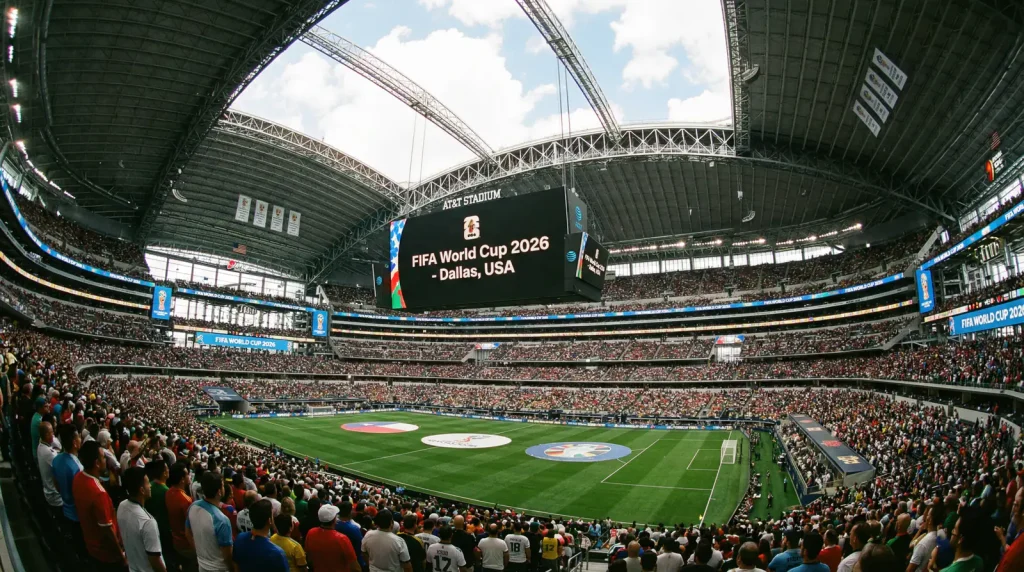
Table of Contents
Nine matches — more than any other venue in the tournament. AT&T Stadium’s allocation for World Cup 2026 makes this Arlington, Texas facility the statistical centre of gravity for the entire competition. When FIFA distributed fixtures across 16 host stadiums, they concentrated 8.7% of all matches in a single building designed primarily for American football. I’ve examined this venue extensively, and the sheer volume of fixtures assigned here demands particular attention from anyone following World Cup betting markets.
The numbers tell the venue’s story immediately: 80,000 seated capacity expandable to 100,000 for major events, a retractable roof spanning 275 metres that creates climate-controlled conditions, and a construction cost of A$1.9 billion when completed in 2009 — making it among the most expensive sporting venues ever built. For World Cup 2026, AT&T Stadium hosts fixtures from opening group stage through semi-finals, representing the tournament’s most comprehensive single-venue schedule.
Technical Specifications and Infrastructure
Jerry Jones — Dallas Cowboys owner and the visionary behind AT&T Stadium — famously said he wanted to build “the greatest stadium in the world.” Whether that claim holds depends on your criteria, but the technical specifications certainly compete with any venue globally. What matters for World Cup purposes is how those specifications translate to international football conditions, and the answer involves significant temporary modifications to American football infrastructure.
The retractable roof system dominates any discussion of AT&T Stadium’s capabilities. Two arched panels, each weighing 12,000 tonnes, open or close in approximately 12 minutes depending on weather conditions. For World Cup matches, roof position becomes a genuine tactical consideration — open roof in Texas summer creates vastly different playing conditions than the climate-controlled environment possible with closed roof operation.
| Specification | AT&T Stadium Data |
|---|---|
| Standard Capacity | 80,000 (seated) |
| Maximum Capacity | 100,000+ (with standing) |
| World Cup Capacity | 92,000 (estimated) |
| Playing Surface | Natural grass (temporary installation) |
| Pitch Dimensions | 105m x 68m (FIFA standard) |
| Roof Type | Retractable (275m span) |
| Altitude | 180 metres above sea level |
| Opened | 2009 |
| Construction Cost | A$1.9 billion |
| Centre Hung Display | 160m x 22m (world’s largest indoor) |
The centre-hung video display deserves mention for its sheer audacity — measuring 160 metres long and 22 metres high, it remains the world’s largest indoor video board. During football matches, this creates an unusual viewing dynamic where spectators in upper levels may watch significant portions of play on the screen rather than the distant pitch below. The display weighs 1,200 tonnes and hangs approximately 27 metres above the playing surface, positioning it well clear of any aerial play concerns.
Playing surface presents the most significant adaptation challenge. AT&T Stadium’s permanent surface is synthetic turf optimised for American football — unsuitable for FIFA competition requirements. For World Cup 2026, a natural grass system will be installed temporarily, likely using portable tray technology similar to that employed at other NFL stadiums hosting international football. This temporary grass surface requires careful management, particularly given the limited natural light penetration beneath the domed roof structure.
Climate control capabilities set AT&T Stadium apart from open-air venues. With roof closed, air conditioning maintains interior temperatures regardless of external conditions — significant when June temperatures in North Texas regularly exceed 35°C. This creates genuinely different playing conditions than outdoor venues in similar climate zones, potentially affecting player fatigue calculations, over/under markets, and late-game performance patterns.
World Cup 2026 Match Schedule
Nine matches across four weeks transforms AT&T Stadium into something approaching a continuous World Cup operation. The schedule spans from opening weekend group fixtures through a semi-final, meaning this single venue will host matches at every competitive intensity level except the final itself. For punters tracking venue-specific patterns, this concentration creates the tournament’s largest single-stadium sample size.
| Date | Match | Stage | Local Time (CT) | AEST |
|---|---|---|---|---|
| Thu 12 June | Mexico vs South Korea | Group A | 18:00 | Fri 09:00 |
| Sat 14 June | Canada vs Bosnia & Herzegovina | Group B | 14:00 | Sun 05:00 |
| Sun 15 June | Netherlands vs Tunisia | Group F | 20:00 | Mon 11:00 |
| Tue 17 June | France vs Iraq | Group I | 15:00 | Wed 06:00 |
| Fri 20 June | Colombia vs DR Congo | Group K | 18:00 | Sat 09:00 |
| Mon 23 June | Japan vs Sweden | Group F | 21:00 | Tue 12:00 |
| Wed 25 June | France vs Norway | Group I | 18:00 | Thu 09:00 |
| Wed 2 July | Round of 32 Match | Knockout | 17:00 | Thu 08:00 |
| Tue 8 July | Semi-Final 1 | Knockout | 18:00 | Wed 09:00 |
For Australian viewers, AT&T Stadium’s Central Time zone location produces accessible viewing times across most fixtures. The semi-final lands at Wednesday 09:00 AEST — ideal for morning viewing before work or during lunch breaks. Group stage matches span from early morning to midday AEST, with the Netherlands vs Tunisia fixture offering the most comfortable Monday 11:00 AEST slot.
Mexico’s opening match against South Korea draws particular attention given the venue’s proximity to the Mexico-United States border. AT&T Stadium sits approximately 850 kilometres from the border, close enough that Mexican supporter travel becomes genuinely feasible. Previous international matches at this venue have drawn substantial Mexican fan presence, and World Cup group stage fixtures will likely see similar demographic patterns in attendance.
France appears twice in the group stage schedule — a concentration that gives their squad extended familiarity with venue conditions, training facilities, and regional logistics. Whether this represents meaningful advantage depends on various factors, but the scheduling does create unusual consistency for one of the tournament favourites. Norway and Iraq complete France’s group opponents at AT&T Stadium, with the France vs Norway fixture carrying significant Group I implications.
Arlington Location and Regional Context
AT&T Stadium sits in Arlington, Texas — positioned almost exactly midway between Dallas and Fort Worth in the heart of the Dallas-Fort Worth metroplex. This geographic reality matters more than most venue analyses acknowledge: Arlington lacks comprehensive public transportation, meaning virtually all spectator access depends on automobile travel, rideshare services, or organised shuttle operations.
Dallas/Fort Worth International Airport provides primary arrival access, located approximately 25 kilometres north of AT&T Stadium. This major hub offers direct international connections from most participating nations, eliminating the multi-stop itineraries required for some regional venues. Dallas Love Field serves as secondary option, primarily for domestic connections. Both airports operate substantial ground transportation networks, though neither offers direct rail service to Arlington.
The absence of public rail to AT&T Stadium represents a genuine operational challenge. While DART (Dallas Area Rapid Transit) operates extensive light rail throughout Dallas County, Arlington consistently voted against joining the transit system, leaving private vehicles as the primary access mode. For World Cup operations, FIFA and local organisers have committed to expanded shuttle services from Dallas and Fort Worth, though capacity constraints during high-demand fixtures remain a planning concern.
Hotel inventory throughout the metroplex substantially exceeds single-venue capacity, providing options ranging from budget properties to luxury accommodations. Downtown Dallas sits approximately 30 kilometres east, offering entertainment districts, dining options, and direct connection to airport rail service. Fort Worth’s Sundance Square district provides alternative dining and nightlife approximately 20 kilometres west. Arlington itself contains primarily chain hotels clustered near the stadium and adjacent entertainment complexes.
Training facility availability throughout the region meets elite requirements. FC Dallas operates a dedicated training facility in Frisco, approximately 50 kilometres north. Several university programmes — Southern Methodist University, University of North Texas, Texas Christian University — maintain football-specific infrastructure suitable for national team preparation. The Toyota Stadium (FC Dallas home ground) offers an additional match-quality grass venue for training purposes during tournament periods.
Climate Factors and Roof Considerations
I’ve analysed temperature data for AT&T Stadium events across multiple summers, and the roof status emerges as the single most significant environmental variable. With roof open, playing conditions mirror the brutal North Texas summer — average June highs of 34°C, July highs of 36°C, and humidity levels that create genuine physiological stress. With roof closed, consistent 21-22°C temperatures create European-like conditions regardless of external weather.
FIFA’s decision on roof positioning for each match will significantly affect betting market considerations. Historical precedent from other retractable-roof venues suggests organisers prefer closed-roof operations for player welfare and broadcast consistency, but environmental sustainability concerns and spectator experience preferences may argue for open-roof daytime fixtures. As of my analysis, no official protocol has been announced for World Cup 2026 roof management.
| Climate Factor | Roof Open (Outdoor) | Roof Closed (Controlled) |
|---|---|---|
| June Temperature | 34°C average high | 21-22°C controlled |
| July Temperature | 36°C average high | 21-22°C controlled |
| Humidity | 50-65% variable | 45-55% controlled |
| UV Exposure | Extreme (index 10-11) | Minimal |
| Playing Surface Impact | Higher stress, faster drying | Controlled moisture, consistent |
North Texas thunderstorm patterns peak during late afternoon hours in June and July, creating potential disruption for outdoor fixtures. Unlike Miami’s rapid-developing tropical systems, Texas storms typically provide more advance warning but can produce severe conditions including large hail, damaging winds, and tornado activity. The retractable roof provides obvious shelter, but roof closure during active thunderstorms may not be advisable due to structural wind load considerations.
Altitude at 180 metres above sea level presents no meaningful physiological challenge — effectively sea level conditions for all practical purposes. This distinguishes AT&T Stadium from the Mexican venues where Estadio Azteca’s 2,200-metre altitude creates genuine acclimatisation requirements.
Venue History and Operational Experience
Since opening in 2009, AT&T Stadium has hosted events at every scale American sports offers — Super Bowls, NCAA Final Fours, championship boxing, major concerts, and international football. That operational breadth matters for World Cup readiness, as venue staff have managed crowd flows, broadcast operations, and security protocols for audiences exceeding 100,000 across diverse event types.
International football experience at AT&T Stadium includes regular appearances by Liga MX clubs, international friendlies featuring CONCACAF and European national teams, and Gold Cup fixtures. These events consistently draw crowds exceeding 60,000, with Mexican club matches approaching capacity through the substantial Mexican-American population in the Dallas-Fort Worth region. The venue’s capacity to manage international football-specific crowd dynamics has been demonstrated across dozens of fixtures.
Super Bowl XLV in 2011 provided the venue’s most comprehensive operational test — over 103,000 attendees for a single sporting event, with global broadcast operations and security requirements approximating World Cup standards. More recent large-scale events include the 2014 NCAA Men’s Basketball Final Four and multiple College Football Playoff fixtures, each drawing capacity crowds and complex logistics requirements.
The stadium’s technological infrastructure positions it among the most broadcast-ready venues globally. Over 3,000 Sony HD displays throughout the facility, a distributed antenna system supporting cellular connectivity for capacity crowds, and broadcast facilities designed for simultaneous multi-platform production create operational flexibility that World Cup requirements demand.
Betting Analysis and Venue Factors
Nine matches at a single venue creates analytical opportunity that single-fixture allocations cannot match. By the semi-final, I will have tracked goal patterns, injury incidents, and performance metrics across eight preceding fixtures at AT&T Stadium — enough data to identify venue-specific trends if they exist. For punters following the tournament systematically, this concentration rewards attention to early results.
The roof variable introduces uncertainty that other venues lack. If roof positioning follows a consistent pattern — always closed, always open, or weather-dependent — betting analysis can adapt accordingly. If positioning varies without clear pattern, the uncertainty itself becomes a factor, potentially creating value in markets where roof impact is mispriced.
Crowd composition affects atmosphere in ways that occasionally influence match dynamics. Mexico vs South Korea and France vs Norway will likely draw distinctly different supporter demographics, with Mexican-American fans potentially creating significant home-side atmosphere despite neutral venue designation. Whether crowd support translates to measurable on-pitch advantage remains debated, but the betting markets sometimes underweight such factors in early pricing.
The semi-final allocation represents the venue’s highest-stakes fixture — and the point where historical venue data becomes most valuable. Teams reaching semi-finals will have demonstrated tournament fitness and form that matters more than any single-venue factor. Yet environmental conditions, crowd dynamics, and accumulated venue-specific patterns all contribute to the analytical picture. AT&T Stadium’s nine-match schedule provides more context for that semi-final analysis than any other venue in the tournament.
