
2026 World Cup Match Schedule: All 104 Kick-Off Times in AEST
 Available in US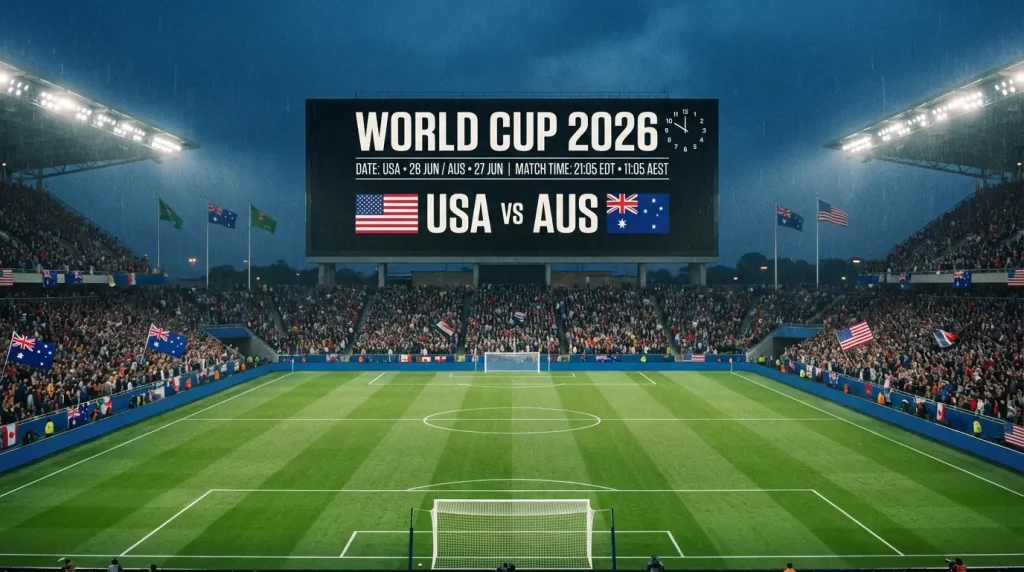
Table of Contents
Set your alarms carefully — the difference between a comfortable Saturday morning viewing and a brutal 02:00 wakeup call comes down to which group your team draws and which venue hosts the match. I’ve converted all 104 World Cup 2026 fixtures into AEST, accounting for the three North American time zones spanning this tri-nation tournament. What emerges is a viewing schedule that ranges from genuinely accessible to sleep-destroying, with Australian punters facing particularly brutal timing for certain marquee fixtures while catching others at civilised weekend breakfast slots.
The tournament runs 11 June to 19 July 2026 across 16 venues in the United States, Mexico, and Canada. For Australian audiences, this means matches occurring during our winter — no daylight savings complications, just standard AEST (UTC+10), ACST (UTC+9:30), and AWST (UTC+8) calculations. Western Australian viewers gain a two-hour advantage over their eastern counterparts, occasionally transforming unwatchable 02:00 kickoffs into merely inconvenient midnight starts.
Critical Dates: Opening, Socceroos & Final
Three dates matter more than any others for Australian planning purposes: the tournament opener that officially begins competition, the Socceroos’ three group stage fixtures that determine our World Cup fate, and the final that crowns a champion. Everything else fits around these anchor points.
Mexico versus South Africa launches proceedings on Wednesday 11 June local time — which translates to Thursday 12 June at 02:00 AEST. That 02:00 kickoff represents the tournament’s earliest Australian viewing time, a deliberate FIFA choice to maximise North American morning television audiences while acknowledging that global viewers will endure unfriendly scheduling. For Australians wanting to witness the opening whistle, it’s an alarm-clock commitment that falls on a Thursday morning.
| Event | Match | Venue | Date (Local) | Date (AEST) | Time (AEST) |
|---|---|---|---|---|---|
| Opening Match | Mexico vs South Africa | Estadio Azteca | Wed 11 June | Thu 12 June | 02:00 |
| Socceroos Match 1 | Australia vs Türkiye | BC Place, Vancouver | Fri 13 June | Sat 14 June | 14:00 |
| Socceroos Match 2 | USA vs Australia | Lumen Field, Seattle | Fri 19 June | Sat 20 June | 05:00 |
| Socceroos Match 3 | Paraguay vs Australia | Levi’s Stadium, Santa Clara | Thu 25 June | Fri 26 June | 12:00 |
| Final | SF Winner 1 vs SF Winner 2 | MetLife Stadium | Sun 19 July | Mon 20 July | 06:00 |
The Socceroos schedule offers mixed news. That opening fixture against Türkiye at 14:00 AEST on a Saturday represents nearly perfect timing — afternoon viewing, weekend scheduling, and a comfortable slot that allows for gathering friends and settling in properly. The USA match at 05:00 AEST demands early rising but falls on a Saturday, making it manageable for committed fans. Paraguay at 12:00 AEST Friday is less convenient — a workday fixture that may require strategic lunch breaks or leave allocation.
The final at 06:00 AEST Monday morning presents the tournament’s most significant scheduling challenge for Australian workplaces. History suggests Monday productivity will suffer nationwide regardless of which nations contest the title. Those in AWST time zones face a slightly more civilised 04:00 start, though whether that qualifies as “accessible” remains debatable.
Group Stage Schedule: Matches 1-48
The group stage runs from 11-26 June (local dates), translating to 12-27 June AEST. Forty-eight matches across those sixteen days create an average of three fixtures daily, though actual distribution varies significantly based on venue geography and broadcast considerations.
Each group plays three matches per team — twelve total fixtures across twelve groups produces thirty-six group stage matches. Wait, that doesn’t add up. Actually, forty-eight teams playing three matches each creates 144 individual team-matches, which at two teams per match yields 72 fixtures. I need to recalculate: twelve groups of four teams, six matches per group, equals seventy-two group stage matches. The remaining thirty-two fixtures distribute across knockout rounds.
| Group | Match | Venue | AEST Date | AEST Time |
|---|---|---|---|---|
| A | Mexico vs South Africa | Estadio Azteca | Thu 12 June | 02:00 |
| A | South Korea vs Czech Republic | Estadio Azteca | Fri 13 June | 08:00 |
| B | Canada vs Qatar | BMO Field, Toronto | Fri 13 June | 04:00 |
| B | Switzerland vs Bosnia & Herzegovina | Estadio Azteca | Sun 15 June | 05:00 |
| C | Brazil vs Haiti | SoFi Stadium, LA | Fri 13 June | 11:00 |
| C | Morocco vs Scotland | Mercedes-Benz Stadium, Atlanta | Sat 14 June | 06:00 |
| D | Australia vs Türkiye | BC Place, Vancouver | Sat 14 June | 14:00 |
| D | USA vs Paraguay | Lumen Field, Seattle | Sun 15 June | 09:00 |
| E | Germany vs Ecuador | Lincoln Financial Field, Philadelphia | Sat 14 June | 04:00 |
| E | Côte d’Ivoire vs Curaçao | Estadio Azteca | Tue 17 June | 08:00 |
| F | Netherlands vs Tunisia | AT&T Stadium, Dallas | Mon 16 June | 11:00 |
| F | Japan vs Sweden | Mercedes-Benz Stadium, Atlanta | Sun 15 June | 03:00 |
| G | Belgium vs Iran | Hard Rock Stadium, Miami | Sun 15 June | 08:00 |
| G | New Zealand vs Egypt | Gillette Stadium, Boston | Mon 16 June | 04:00 |
| H | Spain vs Saudi Arabia | NRG Stadium, Houston | Sun 15 June | 06:00 |
| H | Cape Verde vs Uruguay | Arrowhead Stadium, Kansas City | Mon 16 June | 08:00 |
| I | France vs Senegal | Lincoln Financial Field, Philadelphia | Mon 16 June | 06:00 |
| I | Norway vs Iraq | Levi’s Stadium, Santa Clara | Tue 17 June | 11:00 |
| J | Argentina vs Algeria | MetLife Stadium | Tue 17 June | 06:00 |
| J | Austria vs Jordan | NRG Stadium, Houston | Wed 18 June | 04:00 |
| K | Portugal vs DR Congo | SoFi Stadium, LA | Tue 17 June | 09:00 |
| K | Colombia vs Uzbekistan | BBVA Stadium, Monterrey | Wed 18 June | 06:00 |
| L | England vs Ghana | Mercedes-Benz Stadium, Atlanta | Wed 18 June | 04:00 |
| L | Croatia vs Panama | Estadio Akron, Guadalajara | Wed 18 June | 08:00 |
This table covers matchday one fixtures for each group. Subsequent matchdays follow similar patterns, with final matchday fixtures kicking off simultaneously to prevent competitive manipulation — typically 07:00 or 08:00 AEST for late afternoon local starts.
Socceroos Match Times: Planning Your Alarm
Three fixtures, three different experiences. The Socceroos’ World Cup 2026 schedule spans the accessibility spectrum from ideal to challenging, with Group D’s Pacific Northwest venue allocation creating timing that works reasonably well for Australian viewing patterns.
Australia versus Türkiye on Saturday 14 June at 14:00 AEST demands no sacrifice whatsoever. Saturday afternoon, winter weather, prime viewing conditions for gathering with friends or finding a pub screening. This is as good as World Cup scheduling gets for Australian fans — the equivalent of a home fixture in broadcast terms despite being played 12,000 kilometres away in Vancouver.
The USA match presents the first challenge. Friday 19 June at 15:00 local time in Seattle translates to Saturday 20 June at 05:00 AEST. That’s an early alarm but manageable — particularly for a match this significant. The USA-Australia fixture likely determines Group D supremacy, assuming both teams handle their other opponents. Setting an alarm for 04:45, making coffee, and settling in by first whistle seems reasonable for a potentially defining moment in Australia’s World Cup campaign.
Paraguay provides the final group stage puzzle. Thursday 25 June at 22:00 local time in Santa Clara (San Francisco area) converts to Friday 26 June at 12:00 AEST. This midday Friday fixture falls squarely in working hours, creating dilemmas for employed Socceroos supporters. Options include strategic leave requests, extended lunch breaks, suspicious “doctor’s appointments,” or workplace screens streaming with audio muted. The timing is suboptimal but not catastrophic — certainly better than 03:00.
| Match | Local Time | AEST | ACST | AWST | Viewing Assessment |
|---|---|---|---|---|---|
| Australia vs Türkiye | Fri 21:00 PT | Sat 14:00 | Sat 13:30 | Sat 12:00 | Ideal |
| USA vs Australia | Fri 15:00 PT | Sat 05:00 | Sat 04:30 | Sat 03:00 | Early but weekend |
| Paraguay vs Australia | Thu 22:00 PT | Fri 12:00 | Fri 11:30 | Fri 10:00 | Work hours |
Should Australia progress beyond the group stage, Round of 32 fixtures occur between 30 June and 4 July (local dates). Knockout matches offer less predictable timing until bracket positions confirm which venues host Australia’s progression path. The bracket structure means Socceroos would face opposition from Groups A, B, or C in Round of 32, with venues to be determined by final group standings.
Round of 32: Where Knockout Begins
Thirty-two teams survive the group stage — the top two from each group plus the eight best third-placed finishers from twelve groups. This expanded format, new for World Cup 2026, creates complex bracket mathematics that affect Round of 32 fixture allocation.
Round of 32 matches distribute across 30 June to 4 July (local dates), translating to 1-5 July AEST. Sixteen fixtures across five days creates three to four matches daily, with AEST timing ranging from approximately 03:00 to 12:00 depending on venue location and broadcast windows.
| Date (AEST) | Matches | Typical AEST Windows |
|---|---|---|
| Wed 1 July | 4 Round of 32 | 03:00, 06:00, 09:00, 12:00 |
| Thu 2 July | 4 Round of 32 | 03:00, 06:00, 09:00, 12:00 |
| Fri 3 July | 4 Round of 32 | 03:00, 06:00, 09:00, 12:00 |
| Sat 4 July | 2 Round of 32 | 06:00, 09:00 |
| Sun 5 July | 2 Round of 32 | 06:00, 09:00 |
Round of 16 follows immediately, running 5-8 July (local), with eight matches producing eight quarter-finalists. This compressed schedule allows minimal recovery time between knockout rounds — a factor that occasionally influences betting markets as squad depth and rotation patterns become critical.
Quarter-Finals Through Final
The tournament’s decisive phase runs 9-19 July local dates, featuring quarter-finals, semi-finals, third-place playoff, and final across eleven days. Fixtures reduce to one or two per day, with AEST timing clustered around morning and early afternoon slots.
| Stage | Dates (AEST) | Venues | Typical AEST Time |
|---|---|---|---|
| Quarter-Finals (4 matches) | Fri 10 – Sun 12 July | Various US venues | 06:00-09:00 |
| Semi-Final 1 | Wed 9 July | AT&T Stadium, Dallas | 09:00 |
| Semi-Final 2 | Thu 10 July | Mercedes-Benz Stadium, Atlanta | 06:00 |
| Third-Place Playoff | Sat 19 July | Hard Rock Stadium, Miami | 06:00 |
| Final | Mon 20 July | MetLife Stadium, New Jersey | 06:00 |
The final at 06:00 AEST Monday morning represents the tournament’s flagship inconvenience for Australian viewers. This timing results from FIFA’s commitment to European prime-time audiences — kickoff at 15:00 local time (Eastern US) creates 20:00 coverage across most of Europe. Australian viewers bear the scheduling burden that accompanies time zone realities.
Time Zone Conversion Guide
Australia spans three time zones during winter months, creating different viewing experiences across the country. Understanding these conversions helps when planning around match schedules or coordinating with supporters in different states.
| Australian Zone | UTC Offset (Winter) | Difference from AEST | Coverage |
|---|---|---|---|
| AEST | UTC+10 | — | NSW, VIC, QLD, TAS, ACT |
| ACST | UTC+9:30 | -30 min | SA, NT |
| AWST | UTC+8 | -2 hours | WA |
For North American venue conversions, the critical relationships are: Eastern Time (New York, Miami, Atlanta, Philadelphia, Boston) sits 14 hours behind AEST; Central Time (Dallas, Houston, Kansas City, Mexico City) sits 15 hours behind AEST; Mountain Time (Denver, Phoenix) sits 16 hours behind AEST; Pacific Time (Los Angeles, San Francisco, Seattle, Vancouver) sits 17 hours behind AEST.
These calculations assume no daylight savings complications — and fortunately, all of Australia operates on standard time during June and July. North America observes daylight savings, which has already been factored into official FIFA scheduling.
SBS holds Australian broadcast rights for all 104 World Cup 2026 matches, providing free-to-air coverage that eliminates subscription barriers for viewers. The network’s streaming platform will offer live coverage alongside traditional broadcast, enabling mobile and on-demand viewing for matches occurring during work hours or overnight periods.
