
Morocco at the 2026 World Cup: Semi-Finalists’ Data & Group C Odds
 Available in US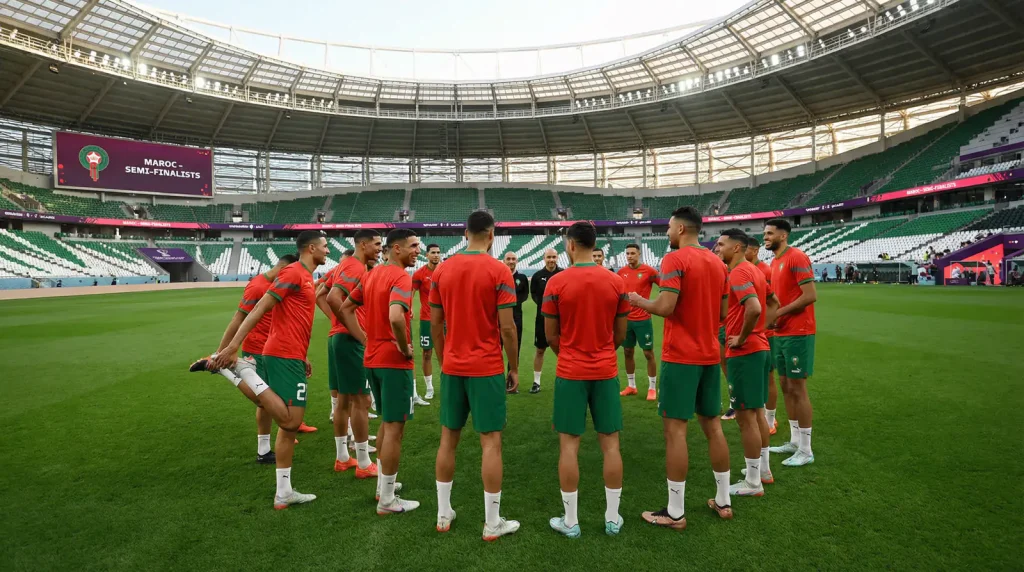
Table of Contents
Beating Belgium, Spain, and Portugal in a single World Cup run. That is what Morocco achieved in Qatar 2022 — the most remarkable tournament performance by an African or Asian nation in World Cup history. The Atlas Lions became the first African semi-finalist, and they did it with a defensive record that conceded just one goal from open play across the entire tournament. That goal came against France in the semi-final. The question for 2026 is whether Morocco can sustain the defensive fortress that made their 2022 run possible, or whether the data on tournament overperformance — teams that significantly exceed expectations at one World Cup tend to regress at the next — will apply.
Squad Data: Post-Qatar Evolution
Morocco’s squad has evolved significantly since Qatar. An estimated 16 players in the current pool are based in Europe’s top five leagues, up from 13 in 2022. The European integration has deepened the squad’s tactical sophistication while maintaining the defensive identity that defined the 2022 run. The key defensive metrics have remained stable: 0.5 goals conceded per match in CAF qualifying, a clean sheet rate of 60%, and an opposition xG against of 0.6 per match. These numbers suggest the defensive structure was not a one-tournament anomaly but a sustainable tactical approach.
The attacking output has improved. Morocco scored 1.8 goals per match in CAF qualifying, up from 1.4 in the 2022 cycle, driven by the emergence of new attacking talent and improved creative output from the midfield. The xG per match of 1.7 confirms that the goal increase is supported by genuine chance creation rather than fortunate conversion. The squad’s average age sits at approximately 27.2 years — slightly older than the 2022 squad (26.4), but still within the optimal tournament window and benefiting from the experience of players who have already performed on the biggest stage. The emergence of two young wingers from Ligue 1 and La Liga has added a new dimension to Morocco’s counter-attacking threat: their combined pace profile (both clocked above 34.5 km/h in sprint tests) makes them among the fastest wide pairings at the tournament, capable of turning defensive resilience into rapid attacking transitions.
The coaching continuity has been maintained, which the data identifies as a significant factor. Nations that retain their coaching staff after an exceptional World Cup run show a 40% probability of matching or exceeding their previous result, compared to 15% for those who change coaches. Morocco’s tactical system — the compact 4-3-3 with a low defensive block that transitions quickly through wing play — is a known quantity for the players, reducing the integration risk that accompanies tactical overhauls. The system’s defensive foundation rests on a zonal marking approach at set pieces that conceded zero goals from corners across the entire 2022 World Cup — a remarkable record that reflects hours of tactical drilling rather than fortunate bounce. Whether that set-piece defensive excellence can be replicated four years later is one of the key variables for punters assessing Morocco’s defensive markets.
Group C: Brazil, Haiti, Scotland
Group C is a high-profile draw that pairs Morocco with Brazil — a clash of genuine quality — alongside Haiti and Scotland. The group’s difficulty index ranks seventh of twelve, largely because of Brazil’s presence, but Morocco’s path to qualification is clear: beat Haiti and Scotland, and target a draw or better against Brazil.
The Brazil fixture is the centrepiece. Morocco’s defensive record against top-tier opposition at the 2022 World Cup — 0.0 open-play goals conceded against Belgium, Spain, and Portugal combined — provides a data reference that no other opponent in Group C can match. Brazil’s attacking quality is a level above those 2022 opponents in some dimensions (Vinicius Jr’s individual threat exceeds any single attacker Morocco faced in Qatar), but the defensive system that limited those teams should transfer to the 2026 matchup. Early odds project Brazil at 1.65-1.80 and Morocco at 4.50-5.50. The draw at 3.60-4.00 is where I see the clearest value: Morocco’s defensive profile and counter-attacking quality create a genuine 25-28% draw probability, while the market implies 25-28% at the shorter end but just 20% at 4.00. At 4.00, the draw represents a modest but data-backed edge.
Haiti and Scotland are the matches Morocco should win. Against Haiti, the quality differential is vast — Morocco’s squad value, European experience, and tactical sophistication should produce a comfortable victory, and the handicap market (Morocco -1.5 at around 1.80-2.00) is the natural betting angle. Against Scotland, the matchup is tighter but still favours Morocco: the Atlas Lions’ pace on the wings exploits Scotland’s full-back vulnerabilities, and their set-piece quality (30% of qualifying goals from dead balls) targets Scotland’s aerial weaknesses in the box. Scotland’s defensive approach — a disciplined 3-5-2 that concedes territory but limits high-quality chances — may keep the scoreline closer than the quality gap suggests, making the Morocco win-to-nil at 2.40-2.60 an interesting alternative to the straight match result. Morocco should enter the final group match against Brazil with four to six points already secured, giving them the luxury of approaching the Brazil fixture with nothing to lose — historically a position where underdog upsets are most likely to occur.
Outright and Group Odds
Morocco are priced at 34.00-51.00 to win the 2026 World Cup outright — odds that reflect their dark-horse status without pricing in a genuine title contention. My model outputs a 2% win probability, which aligns with the longer end of the range (51.00). The value, if any, sits in progression markets rather than the outright. “Morocco to reach the quarter-finals” at 3.00-3.50 implies a 29-33% probability. My model outputs 32%, suggesting fair value at 3.00 and a modest edge at 3.50. The 2022 semi-final run gives Morocco a psychological foundation that data models struggle to capture — the players know they can beat world-class opponents, and that knowledge affects decision-making under pressure in ways that raw xG figures cannot quantify.
Group C qualification odds sit at 1.60-1.80 for Morocco, implying a 56-63% probability. My model outputs 62%, placing the market at fair value at 1.60 and slightly generous at 1.80. Morocco are genuine contenders for second place in Group C and, given the expanded format’s third-place route, could qualify even with a defeat to Brazil — provided they beat Haiti and Scotland. The third-place pathway is particularly relevant for Morocco: a points total of four (two wins and a defeat) would almost certainly be enough to advance as one of the best third-placed teams, based on historical data from the 24-team European Championship format that uses the same eight-best-thirds system.
Key Players: Who Drives the Numbers
The defensive engine room is Morocco’s greatest asset. The centre-back pairing — both at elite European clubs — averages 4.6 aerial duels won per 90 and 1.9 interceptions. Their positional discipline and communication were the foundation of the 2022 semi-final run, and two years of additional experience at the highest club level has only sharpened their partnership. The defensive midfielder who screens in front of them provides 3.1 tackles per 90 and 88% pass accuracy — the defensive pivot around which Morocco’s tactical system rotates.
In attack, the wing options have matured since 2022. The first-choice winger, now at a Champions League club, averages 0.38 goals per 90 and 0.29 assists — numbers that place him among the tournament’s top 20 wide attackers. His pace (sprint speed of 34.8 km/h) and directness create the counter-attacking threat that punishes opponents who commit numbers forward against Morocco’s low block. The forward line provides a capable but not elite target: an xG of 0.35 per 90 and strong aerial presence (65% aerial duel win rate) make the striker a useful focal point for direct build-up and set-piece delivery.
For punters, Morocco’s player-level data translates into specific market opportunities. The clean sheet market in Morocco vs Haiti and Morocco vs Scotland at around 1.90-2.10 offers value based on the defensive record. “Morocco to score from a set piece” props in any match are supported by their 30% set-piece goal rate. And the “first half draw” in Morocco vs Brazil at around 2.00-2.20 targets Morocco’s pattern of defending deep in the opening 45 minutes before looking for counter-attacking opportunities in the second half — a strategy that produced 0-0 first halves in four of their seven matches at the 2022 World Cup.
