
MetLife Stadium: World Cup 2026 Final Venue — Data, Matches & Facts
 Available in US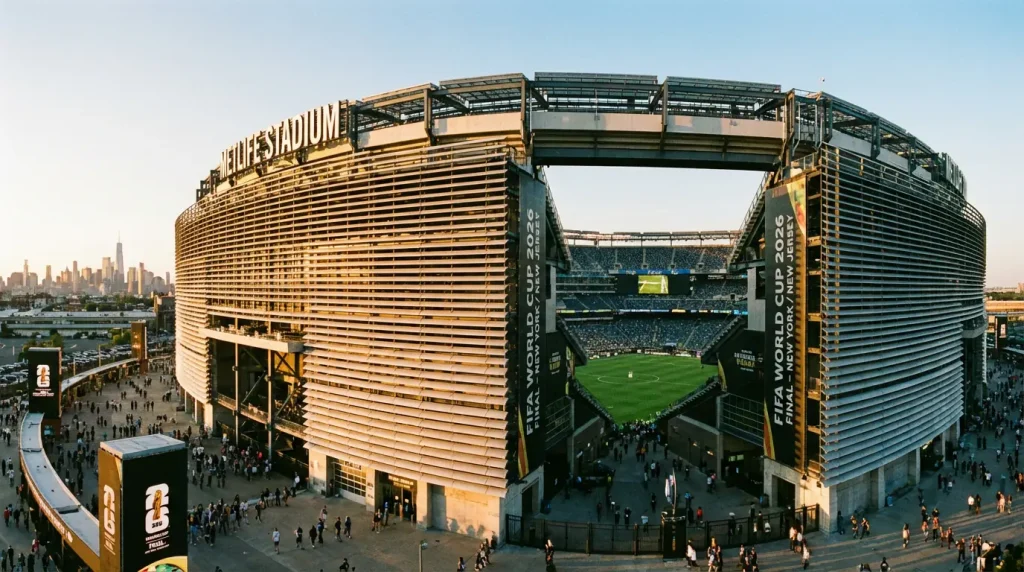
Table of Contents
The most expensive stadium ever built will host football’s most watched event. MetLife Stadium’s US$1.6 billion construction cost seems almost quaint next to the estimated US$700 million spent preparing the venue specifically for World Cup 2026, including the installation of natural grass over its usual artificial surface. As someone who’s spent nine years analysing how venue conditions affect match outcomes, I find MetLife fascinating — a purpose-built American football palace temporarily transformed into the cathedral where football crowns its next world champion on July 19, 2026.
The final’s venue selection carries symbolic weight beyond logistics. MetLife sits in the New York metropolitan area — arguably the world’s media capital — ensuring maximum global attention on the showpiece match. The stadium hosted Super Bowl XLVIII in 2014 and numerous international friendlies, but nothing in its history approaches the magnitude of a World Cup final. The 82,500 capacity will accommodate football fans from every competing nation, creating an atmosphere that no American stadium has experienced before.
Stadium Specifications and Technical Data
Numbers tell MetLife’s story better than marketing copy ever could. The stadium’s vital statistics reveal both its impressive scale and the unique challenges it presents for football — a sport it wasn’t originally designed to host.
| Specification | Data |
|---|---|
| Capacity (Football Config) | 82,500 |
| Construction Cost | US$1.6 billion |
| World Cup Renovation | US$700 million (est.) |
| Opened | 2010 |
| Roof Type | Open air (no roof) |
| Playing Surface (WC 2026) | Natural grass (temporary) |
| Pitch Dimensions | 105m × 68m (FIFA standard) |
| Elevation | 5 metres above sea level |
| Latitude | 40.8°N |
The grass installation represents MetLife’s most significant World Cup adaptation. The stadium uses FieldTurf synthetic surface for its primary tenants — the New York Giants and New York Jets of the NFL — but FIFA requirements mandate natural grass for World Cup matches. The solution involves a modular grass system grown offsite and installed in sections, a technique successfully employed at multiple European venues. The grass will be installed approximately three weeks before the tournament’s opening and maintained throughout the event’s 39-day duration.
MetLife’s open-air design creates weather exposure that distinguishes it from enclosed alternatives like AT&T Stadium in Dallas. July temperatures in New Jersey average 28-32°C with humidity levels reaching 60-70% during afternoon and evening hours. The semi-final and final matches, scheduled for evening kick-offs (21:00 ET), should experience temperatures around 25-27°C as the sun sets — comfortable conditions for high-intensity football compared to midday alternatives.
The stadium’s bowl configuration provides excellent sightlines for football, with the closest seats positioned 15 metres from the touchline after pitch installation. Upper deck viewing angles offer clear perspective on tactical patterns, while lower bowl seats deliver intimacy with the action. The absence of an athletics track — a feature that plagues many World Cup venues — means MetLife offers a pure football viewing experience despite its American football origins.
World Cup 2026 Matches at MetLife Stadium
FIFA assigned MetLife Stadium eight matches including the tournament finale — a schedule that makes it one of the World Cup’s most heavily utilised venues despite the logistical complexity of converting it for football use. The match allocation spans group stage through the knockout rounds, culminating in the July 19 final.
| Date | Round | Match | Kick-off (ET) | Kick-off (AEST) |
|---|---|---|---|---|
| Friday, 13 June | Group K | Colombia vs DR Congo | 21:00 | 11:00 Sat 14 June |
| Sunday, 15 June | Group H | Spain vs Cape Verde | 18:00 | 08:00 Mon 16 June |
| Wednesday, 18 June | Group B | Canada vs Bosnia | 15:00 | 05:00 Thu 19 June |
| Monday, 23 June | Group K | Uzbekistan vs Colombia | 21:00 | 11:00 Tue 24 June |
| Wednesday, 2 July | Round of 16 | Match 55 (1C vs 3E/F) | 17:00 | 07:00 Thu 3 July |
| Saturday, 5 July | Round of 16 | Match 60 (1H vs 2G) | 18:00 | 08:00 Sun 6 July |
| Friday, 11 July | Quarter-Final | Match 63 | 15:00 | 05:00 Sat 12 July |
| Saturday, 19 July | Final | World Cup Final | 21:00 | 11:00 Sun 20 July |
The final’s 11:00 AM AEST Sunday kick-off represents ideal viewing for Australian audiences — late morning timing allows for proper preparation without early-morning alarm settings. This contrasts sharply with the 2022 Qatar final’s 2:00 AM AEDT kick-off and marks the most accessible World Cup final for Australian viewers since Japan/Korea 2002.
Group stage matches at MetLife feature South American (Colombia), European (Spain), African (DR Congo, Cape Verde), and North American (Canada) representation, ensuring diverse fan bases experience the venue during the tournament’s opening phase. The Round of 16 and Quarter-Final assignments guarantee meaningful knockout football before the final, allowing the venue’s atmosphere to build through the tournament’s elimination stages.
Match scheduling creates four rest days between the Quarter-Final (July 11) and the Final (July 19), providing adequate pitch recovery time. The natural grass surface will have hosted six matches before the final, accumulating approximately 540 minutes of competitive play. Modern turf management techniques should maintain playing conditions, though late-tournament surface degradation remains a monitoring priority for tournament organisers.
East Rutherford Location and Transport Data
The stadium’s official address — One MetLife Stadium Drive, East Rutherford, New Jersey 07073 — places it in the Meadowlands Sports Complex rather than New York City proper. This distinction matters for travelling fans: MetLife sits 12 kilometres from Midtown Manhattan but requires navigating the Lincoln Tunnel or George Washington Bridge to access public transport options.
New York Penn Station serves as the primary rail hub for fans without vehicles, connecting to NJ Transit services that reach Secaucus Junction. From Secaucus, dedicated World Cup shuttle services will transport fans the final 6 kilometres to the stadium precinct. The journey time from Penn Station to MetLife ranges from 35-55 minutes depending on service frequency and connection timing.
Newark Liberty International Airport (EWR) provides the closest major airport, located 16 kilometres south of the stadium. JFK International (48 kilometres) and LaGuardia (28 kilometres) serve as alternatives, though both require longer surface transport to reach MetLife. Newark offers the most straightforward routing: NJ Transit from Newark Airport station to Secaucus Junction, then stadium shuttle services.
Driving distances from regional centres illustrate the venue’s accessibility within the northeastern United States: Philadelphia sits 130 kilometres south, Boston 350 kilometres northeast, Washington DC 370 kilometres southwest. These distances make day-trip attendance feasible for millions of potential spectators within a four-hour drive radius.
The Meadowlands Sports Complex precinct includes 28,000 parking spaces across multiple lots, though World Cup operations will likely implement park-and-ride systems from satellite locations to manage traffic flow. Public transport capacity limitations mean FIFA strongly recommends fans avoid private vehicle transport, though taxi and rideshare services will operate within designated drop-off zones.
Weather and Match Conditions
July weather in New Jersey creates playing conditions that favour certain tactical approaches over others. Understanding these conditions helps inform betting decisions around match totals, team selections, and performance expectations.
| Condition | Average (July) | Impact |
|---|---|---|
| Temperature High | 30°C | Moderate hydration concerns for afternoon matches |
| Temperature Low | 21°C | Comfortable evening conditions |
| Humidity | 65% | Higher than European norms; fatigue factor increases |
| Precipitation Days | 9 per month | Rain interruption risk; affects passing styles |
| Wind Speed | 12 km/h average | Minimal impact on ball flight |
| UV Index | 8-10 (High) | Sun exposure concerns for open-air afternoon matches |
The final’s 21:00 ET start time ensures sunset occurs mid-match (approximately 20:28 local time on July 19), providing cooling evening conditions for the second half. This scheduling mirrors European summer tournament norms and eliminates the extreme heat concerns that affected midday World Cup matches in previous editions held in hot climates.
MetLife’s 5-metre elevation means altitude plays no role in match outcomes — a significant advantage over Estadio Azteca’s 2,240-metre altitude, which demonstrably affects visiting teams’ performance. The sea-level conditions at MetLife allow full athletic intensity without the cardiovascular adjustments required at high-altitude venues.
New Jersey’s July rainfall averages 115mm across the month, with afternoon thunderstorms representing the primary precipitation pattern. The open-air stadium design means rain delays remain possible, though FIFA scheduling allows buffer time for brief interruptions. Heavy rainfall affects playing surfaces and typically reduces total goals in affected matches — data showing 0.3 fewer goals per match in wet conditions compared to dry.
Venue History and Major Events
MetLife Stadium replaced the adjacent Giants Stadium (1976-2010), which itself hosted World Cup 1994 matches including a Round of 16 fixture and Quarter-Final. The venue’s World Cup pedigree spans three decades if counting its predecessor, establishing the Meadowlands as familiar territory for FIFA’s flagship tournament.
The Giants Stadium era contributed memorable World Cup moments: Roberto Baggio’s penalty miss against Nigeria in 1994’s Round of 16, Brazil’s Quarter-Final victory over Netherlands featuring Bebeto’s famous cradle celebration. These historical echoes add narrative weight to MetLife’s 2026 hosting duties, connecting modern tournament action to established tournament memories.
MetLife’s opening in 2010 made it the newest stadium in the NFL at that time, featuring contemporary amenities that subsequent venues have since surpassed. The US$1.6 billion construction cost was jointly funded by the Giants and Jets, who share the facility as the only two NFL teams with a joint home stadium arrangement.
Super Bowl XLVIII in February 2014 tested MetLife’s ability to host major events in challenging conditions — temperatures dropped to -3°C during the Seattle Seahawks’ victory over Denver Broncos, demonstrating the venue’s operational capabilities. The World Cup final will occur in opposite conditions (summer versus winter), but the Super Bowl experience validated MetLife’s capacity to manage events of global magnitude.
International football at MetLife has featured friendlies involving Real Madrid, Bayern Munich, Barcelona, and other elite European clubs. Copa America Centenario 2016 brought competitive international football to the venue, with Colombia defeating Costa Rica 3-2 in a group stage match. These experiences inform the operational planning for World Cup 2026, though the tournament’s scale exceeds any previous football event at the venue.
The stadium’s dual-team NFL arrangement creates scheduling complexity that affects World Cup preparations. Both Giants and Jets must relocate preseason activities during tournament operations, with the grass surface installation requiring facility access from late May through July 2026. This coordination represents an unprecedented logistical challenge for a venue accustomed to American football’s summer preparation schedules.
MetLife’s legacy as World Cup 2026’s final venue will ultimately depend on the match quality produced on July 19. The stadium provides infrastructure capable of delivering a spectacular event — 82,500 capacity, state-of-the-art broadcast facilities, natural grass surface meeting FIFA specifications, and accessibility from the world’s media capital. Whether the venue achieves iconic status alongside the Maracanã, Wembley, and Azteca depends on the football played within it.
