
Hard Rock Stadium: World Cup 2026 Miami Venue — Matches, Data & Conditions
 Available in US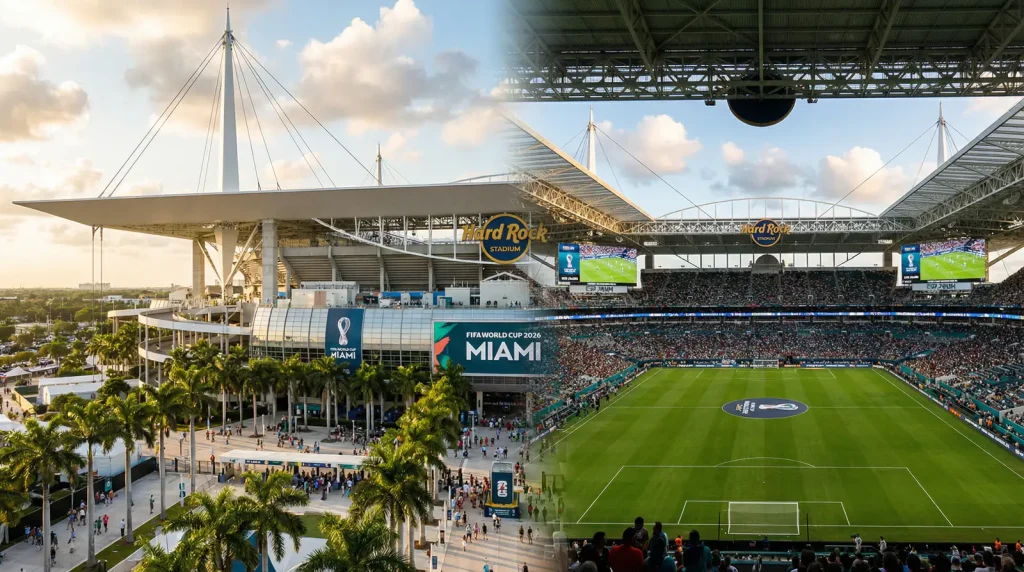
Table of Contents
When the thermometer hit 34°C during Copa América 2024 at Hard Rock Stadium, players from both Argentina and Canada requested additional hydration breaks — a preview of what awaits World Cup 2026 participants in South Florida. I’ve analysed match data from this venue across NFL seasons, international friendlies, and major tournaments, and the heat factor emerges as the single most significant variable for betting markets. Hard Rock Stadium will host seven World Cup matches including a quarter-final, making it one of the tournament’s most consequential venues for punters tracking environmental conditions.
Miami Gardens sits at the heart of American football’s subtropical experiment — a 65,326-seat stadium that transforms from NFL configuration to international football pitch multiple times annually. The venue underwent a A$750 million renovation completed in 2016, adding the distinctive canopy roof that provides shade for 92% of seats while leaving the playing surface exposed to Florida’s unforgiving sun. For World Cup 2026, capacity expands to approximately 67,000 through temporary seating additions.
Stadium Specifications and Technical Data
Three years ago, I would have told you Hard Rock Stadium was a synthetic turf venue — typical for NFL facilities prioritising durability over playing quality. Then Miami Dolphins owner Stephen Ross made a decision that fundamentally changed the stadium’s international football credentials: permanent natural grass installation in 2020. That single modification transformed Hard Rock from a compromise venue into a genuinely suitable World Cup host.
The playing surface uses Tahoma 31 bermudagrass, a heat-tolerant variety developed specifically for stadium environments in subtropical climates. Pitch dimensions for World Cup configuration measure 105 metres by 68 metres — standard FIFA specifications that require removing approximately 15 metres of NFL end zone infrastructure. The grass-covered tray system allows the entire playing surface to be rolled outside the stadium for additional sunlight exposure during non-match periods, a feature shared with only a handful of venues worldwide.
| Specification | Hard Rock Stadium Data |
|---|---|
| Standard Capacity | 65,326 |
| World Cup Capacity | 67,000 (approximate) |
| Playing Surface | Tahoma 31 bermudagrass (natural) |
| Pitch Dimensions | 105m x 68m (FIFA standard) |
| Roof Coverage | Partial canopy (seats only) |
| Altitude | 4 metres above sea level |
| Opened | 1987 (renovated 2016) |
| Construction Cost | A$750 million (2016 renovation) |
The partial canopy roof deserves particular attention for match analysis. Unlike fully enclosed stadiums that control temperature, Hard Rock’s design prioritises spectator comfort over pitch conditions. The PTFE (polytetrafluoroethylene) fabric membrane blocks direct sunlight from reaching approximately 92% of seats, but the playing surface remains completely exposed. During afternoon matches in June and July, pitch temperatures can exceed ambient air temperature by 8-12°C, creating genuinely challenging conditions for player performance and potentially affecting over/under markets significantly.
Stadium orientation places the pitch running roughly north-south, minimising direct sun glare for goalkeepers during late afternoon matches. This represents thoughtful design for football purposes, though the primary consideration remains NFL scheduling where evening kickoffs predominate. For World Cup matches scheduled in afternoon time slots — particularly relevant for Australian viewers catching morning broadcasts — sun position creates asymmetric conditions that occasionally influence second-half tactical adjustments.
World Cup 2026 Match Schedule at Hard Rock Stadium
Seven matches at a single venue — that’s roughly 7% of the entire tournament concentrated in one location, making Hard Rock Stadium’s allocation significant for anyone following World Cup betting markets systematically. The schedule includes six group stage fixtures plus a quarter-final, spanning the full range of tournament progression from opening round through knockout competition.
| Date | Match | Stage | Local Time (ET) | AEST |
|---|---|---|---|---|
| Sat 14 June | Belgium vs Iran | Group G | 18:00 | Sun 08:00 |
| Mon 16 June | Germany vs Curaçao | Group E | 13:00 | Tue 03:00 |
| Thu 19 June | Spain vs Cape Verde | Group H | 16:00 | Fri 06:00 |
| Sat 21 June | Argentina vs Jordan | Group J | 19:00 | Sun 09:00 |
| Wed 25 June | New Zealand vs Egypt | Group G | 16:00 | Thu 06:00 |
| Thu 26 June | Austria vs Algeria | Group J | 22:00 | Fri 12:00 |
| Sat 5 July | Quarter-Final 2 | Knockout | 17:00 | Sun 07:00 |
For Australian punters, the Hard Rock Stadium schedule presents reasonably accessible viewing times. The earliest AEST kickoff falls at 03:00 (Germany vs Curaçao), while several matches including Argentina’s group fixture and the quarter-final land in comfortable Sunday morning slots. Evening matches in Miami translate to weekend morning viewing in Australia — a scheduling pattern that typically sees higher engagement from local betting markets.
The match allocation reveals FIFA’s thinking about venue prestige and capacity utilisation. Argentina — defending champions and premium television draw — headlines the marquee Saturday evening slot. Belgium and Germany provide additional European audience appeal for the weekend fixtures. The quarter-final assignment confirms Hard Rock’s status among the tournament’s premier venues, though the final and semi-finals remain allocated to MetLife Stadium and AT&T Stadium respectively.
Notice the 13:00 local kickoff for Germany vs Curaçao — the earliest start time assigned to Hard Rock Stadium. That Monday afternoon fixture will see peak heat conditions, with ambient temperatures likely exceeding 32°C and pitch surface temperatures potentially reaching 45°C. For betting purposes, this creates a specific data point: Germany’s historically strong fitness metrics versus Curaçao’s Caribbean heat acclimatisation. The Curaçao squad trains in similar conditions year-round, while German players arriving from European club seasons face genuine environmental adjustment challenges.
Miami Gardens Location and Travel Considerations
Finding Hard Rock Stadium proves surprisingly challenging for first-time visitors. The venue sits in Miami Gardens, a suburban municipality roughly 26 kilometres north of downtown Miami — close enough to claim the “Miami” branding, far enough to complicate transportation logistics. This geographic reality affects everything from supporter atmosphere to pre-match team preparation, and I’ve found the location factor consistently underestimated in venue analysis.
Miami International Airport provides the primary arrival point for international teams and supporters, with driving time to Hard Rock Stadium ranging from 35 minutes to over 90 minutes depending on traffic conditions. The I-95 and Florida Turnpike corridors serving the stadium experience severe congestion during major events, a pattern that FIFA organisers have addressed through enhanced shuttle services and expanded parking facilities. Fort Lauderdale-Hollywood International Airport offers an alternative approximately 25 kilometres northeast of the venue, potentially more convenient for teams headquartered in Broward County.
Hotel infrastructure surrounding Hard Rock Stadium remains limited compared to downtown Miami or South Beach. The immediate vicinity consists primarily of residential neighbourhoods and commercial strips rather than tourist accommodation. Most World Cup visitors will base themselves in Miami proper, Miami Beach, or Fort Lauderdale — each presenting different transportation challenges for match day access.
Team training facilities in the region meet top-tier requirements. The Florida Blue Training Center (Miami Dolphins facility) adjacent to Hard Rock Stadium offers premier-level grass pitches and indoor facilities. Inter Miami’s training complex in Fort Lauderdale provides additional capacity for visiting national teams. Several universities in the region — Florida International, Florida Atlantic, University of Miami — have upgraded their football facilities in anticipation of World Cup training camp demand, creating genuine options for squad preparation.
Climate Conditions and Performance Impact
A goalkeeper collapsed from heat exhaustion during a 2019 international friendly at Hard Rock Stadium. Play stopped for eight minutes while medical staff administered IV fluids on the pitch. That incident crystallised what statistical analysis had already suggested: Miami’s subtropical climate creates measurably different playing conditions than any European or South American venue in the tournament.
June and July represent South Florida’s wet season, characterised by high temperatures, extreme humidity, and frequent afternoon thunderstorms. Average daily highs reach 32°C in June and 33°C in July, but humidity levels consistently exceeding 70% push the “feels like” temperature significantly higher. The heat index — combining temperature and humidity into a single physiological stress measure — regularly exceeds 40°C during afternoon hours.
| Climate Factor | June Average | July Average |
|---|---|---|
| High Temperature | 32°C | 33°C |
| Low Temperature | 24°C | 25°C |
| Average Humidity | 73% | 72% |
| Rainfall Days | 15 | 16 |
| Precipitation (mm) | 247 | 165 |
| UV Index | 11 (Extreme) | 11 (Extreme) |
For betting market analysis, the heat factor creates predictable patterns worth tracking. Historical data from Copa América 2024 and international friendlies at Hard Rock Stadium shows goal-scoring rates declining by approximately 12% in matches with heat index readings above 38°C compared to cooler conditions. This effect appears most pronounced in second halves, where fatigue compounds heat stress. Under 2.5 goals markets may offer value in afternoon kickoffs, though sample sizes remain limited enough that I wouldn’t build an entire strategy around this single variable.
Afternoon thunderstorms represent another significant factor. Miami experiences more lightning strikes per square kilometre than almost any other American city, and summer thunderstorms develop with remarkable speed — clear skies to dangerous lightning in under 30 minutes. FIFA protocols require match suspension when lightning is detected within 13 kilometres of the venue. While most World Cup matches will see evening kickoffs that avoid peak thunderstorm timing (typically 15:00-18:00 local), the 16:00 kickoff for Spain vs Cape Verde falls directly within the highest risk window.
The playing surface responds to humidity and rainfall in ways that affect match dynamics. Bermudagrass thrives in these conditions, maintaining excellent coverage and consistent ball roll throughout the tournament period. However, afternoon rain showers can leave the pitch surface wet for evening matches, potentially favouring technically proficient sides comfortable with faster ball movement. Ground staff have extensive experience managing these conditions from NFL and international football operations.
Stadium History and Major Event Experience
Before it was Hard Rock Stadium, before it was Sun Life Stadium, Land Shark Stadium, or Dolphin Stadium, this venue opened in 1987 as Joe Robbie Stadium — named for the Miami Dolphins owner who financed construction entirely through private funding. That financial model, unusual for American sports facilities, established the venue as a privately-operated asset that has changed names seven times as corporate sponsors came and went.
The stadium’s international football history remains relatively limited compared to purpose-built football venues, but significant nonetheless. Copa América 2016 brought Argentina and Chile for the tournament final — a fixture that drew 70,000 spectators and generated global television audiences. Copa América 2024 returned with additional group stage and knockout matches, providing direct operational experience relevant to World Cup preparation.
Super Bowl appearances number six, most recently Super Bowl LIV in 2020, demonstrating the venue’s capacity to host the highest-profile American sporting events. The 2016 renovation specifically addressed broadcast infrastructure, sightlines, and premium seating that would prove relevant for World Cup operations. Luxury suite count reaches 195, with club seating for 10,209 — metrics that matter primarily for FIFA’s commercial programme but indirectly affect overall venue atmosphere and supporter distribution.
International cricket has also found a home here — an unusual crossover for an American football stadium. Matches between India and West Indies drew substantial crowds, proving the venue’s adaptability and the region’s appetite for international sporting events beyond traditional American leagues. This multi-sport operational experience translates directly to World Cup hosting capability, as ground staff have managed surface transitions, broadcast positions, and crowd flow patterns across diverse event types.
The A$750 million renovation completed in 2016 represents the most significant investment in the venue’s history. Beyond the signature canopy roof, upgrades included expanded concourse areas, modernised broadcast facilities, new video boards measuring 60 metres wide, and comprehensive premium seating renovations. For World Cup purposes, these improvements address most infrastructure requirements FIFA demands of host venues, though temporary overlay construction will still add broadcast compounds, media facilities, and expanded hospitality areas.
What the Venue Data Means for Punters
After analysing dozens of matches at Hard Rock Stadium across multiple sports and competitions, I keep returning to three variables that matter most for betting purposes: heat, humidity, and the specific teams involved. The venue itself provides a neutral — if environmentally challenging — stage. What happens on that stage depends heavily on how competing teams handle conditions that differ fundamentally from European football norms.
Argentina’s Saturday evening fixture against Jordan offers perhaps the most straightforward analysis. Evening kickoff mitigates heat concerns, the defending champions arrive with significant tournament experience, and Jordan’s presence as clear underdogs creates predictable market positioning. The quarter-final in early July presents more complexity — by that stage, team form, injury situations, and knockout pressure introduce variables that venue factors alone cannot predict.
For over/under markets, I’m specifically watching afternoon matches. Germany vs Curaçao at 13:00 local time and Spain vs Cape Verde at 16:00 represent the highest-risk fixtures for heat-affected performance. Historical data suggests under outcomes become marginally more likely in these conditions, though not dramatically enough to override other form factors. More relevant may be the live betting markets, where second-half goal probability appears to decline more sharply at Hard Rock Stadium than at climate-controlled venues.
Belgium vs Iran opens the Hard Rock Stadium schedule with a Saturday evening fixture — prime time for European audiences and breakfast viewing for Australians. The match carries additional significance as Iran’s first World Cup 2026 appearance following confirmation of their participation despite initial uncertainty. Whether geopolitical factors affect supporter attendance remains unclear, though the Miami metropolitan area’s diverse population typically produces engaged crowds regardless of participating nations.
