
Group H Data: Spain, Saudi Arabia, Cape Verde, Uruguay — Odds and Predictions
 Available in US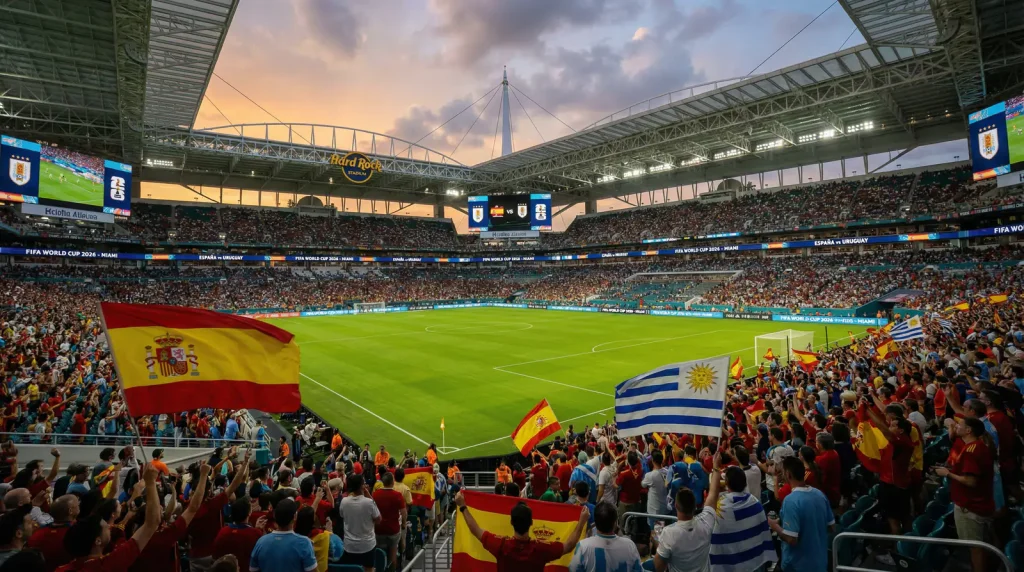
Table of Contents
How do you price a collision between reigning European champions and two-time World Cup winners sharing a group with tournament debutants and Asia’s most dramatic overachievers? Group H delivers exactly this complexity, and bookmakers have responded with some of the most intriguing odds structures in the entire draw. Spain arrive fresh from Euro 2024 glory with the youngest champion squad in tournament history — their average age at that triumph was 26.2 years, with key performers like Lamine Yamal and Pedri barely into their twenties. Uruguay counter with South American grit and a front line featuring Darwin Núñez in his physical prime. Saudi Arabia carry the memory of their Qatar 2022 group stage triumph over Argentina, while Cape Verde write their own history simply by being here. I have tracked Spanish football through multiple generational cycles, and this current vintage may be their most exciting since the Xavi-Iniesta era peaked in 2012.
Spain: Euro Champions with the Data to Back the Hype
The statistics from Euro 2024 border on absurd for a supposedly transitional squad. Spain won all seven matches en route to the title — the first European nation to achieve a perfect tournament since Spain themselves in 2012. They scored fifteen goals and conceded just four. Expected goals data showed they created 14.2 xG while allowing 4.8 xGA, demonstrating underlying quality matching their results rather than fortunate overperformance. This was dominance built on metrics, not luck.
Lamine Yamal drives the narrative, and deservedly so. At just 18 during the 2026 World Cup, he has already accumulated more international assists (9) than most wingers achieve in entire careers. His dribbling success rate (58%) ranks among the highest for any regular starter in Europe’s top five leagues, while his expected assist figures (0.44 per 90) would lead most squads’ creative outputs. The tactical challenge for opponents involves deciding whether to double-mark Yamal, freeing Nico Williams on the opposite flank, or hold defensive shape and absorb the technical overload Spain generate through central combinations.
Pedri orchestrates from the midfield triangle, now fully mature at 24 and with his injury troubles behind him. His passing accuracy (91.3%) and progressive carrying distance (146 metres per 90) make him the system’s heartbeat. Behind him, Rodri provides the defensive screening that allows Pedri and Gavi to roam, while the full-back pairing of Dani Carvajal and Alejandro Balde pushes width that stretches every opponent’s defensive structure.
The question marks exist at centre-back and in goal, where Spain lack the individual quality they possess elsewhere. Unai Simón remains error-prone despite generally competent performances, and the centre-back partnership continues rotating without establishing a definitive first-choice pairing. Against Uruguay’s physical front line, these defensive uncertainties could prove problematic.
Spain to win Group H prices around 1.40 (implied 71%), which I consider roughly accurate. Their tournament pedigree, tactical sophistication, and individual brilliance justify short odds, though the Uruguay fixture carries genuine upset risk that the pricing potentially undervalues.
Uruguay: South American Grit Meets European Scrutiny
Two stars sit on Uruguay’s badge, representing 1930 and 1950 World Cup triumphs that feel distant given their modern tournament struggles. Semi-finalists in 2010 and quarter-finalists in 2018, Uruguay have demonstrated periodic capability at the highest level while never quite threatening to add that third star. The 2026 squad represents their best chance in a decade to change that narrative.
Darwin Núñez headlines the attack after seasons of Premier League adaptation at Liverpool. His raw numbers impress — 0.52 goals per 90 and 0.18 assists across the past two seasons — but advanced metrics reveal inefficiencies that frustrate analysts. His expected goals minus actual goals stands at -4.2 over two seasons, suggesting elite chance creation undermined by poor finishing. For Uruguay, this translates to high-volume attacking threat with maddeningly inconsistent execution.
Behind Núñez, Uruguay’s midfield engine of Federico Valverde and Rodrigo Bentancur provides dynamism lacking in some previous generations. Valverde’s evolution into one of Europe’s most complete midfielders — 2.8 tackles per 90, 3.1 progressive carries, 1.8 shots — gives Uruguay a box-to-box presence that disrupts opposition build-up while contributing offensively. His partnership with Bentancur offers tactical flexibility that Marcelo Bielsa (if he remains in charge) will exploit depending on opponent.
Defensive organisation under Bielsa has improved despite his reputation for attacking commitment. Uruguay conceded just 0.8 goals per match during CONMEBOL qualification, a figure that ranked second in the confederation behind only Argentina. Ronald Araújo anchors the defence when fit, though his injury record creates selection uncertainty that worries analysts tracking Uruguay’s chances.
At odds around 3.40 to win Group H, Uruguay represent genuine value. They match up physically against Spain’s technical approach, possess the individual quality to punish defensive errors, and bring South American tournament mentality that often exceeds European expectations in World Cup settings.
Saudi Arabia: Can They Repeat Argentina’s Nightmare?
November 22, 2022 — a date seared into World Cup folklore. Saudi Arabia defeated Argentina 2-1 in one of the greatest upsets in tournament history, catching Lionel Scaloni’s side cold and executing a high defensive line with suicidal bravery that paid off spectacularly. For precisely 90 minutes, Saudi football reached an apex unlikely to be repeated. Yet here they stand in Group H, with similar upset potential against Spain.
The tactical blueprint from that Argentina match remains available. Hervé Renard, who has since departed, established principles that successor Roberto Mancini has refined rather than abandoned. Saudi Arabia press high when opponents build slowly, compressing space between defensive and midfield lines to create turnover opportunities. Their offside trap success rate against Argentina was remarkable — 10 offsides caught, many on marginal calls that VAR eventually validated.
The squad itself has aged since Qatar, and this presents concerns. Salem Al-Dawsari, the Argentina match hero, turns 34 during the tournament. Mohammed Al-Owais remains a capable goalkeeper but has faced criticism for inconsistency in Asian Champions League appearances. The domestic league concentration — nearly all squad members play in the Saudi Pro League — raises conditioning questions against European opponents who face higher weekly intensity.
Where Saudi Arabia genuinely threaten is against opponents who underestimate them. Spain’s possession dominance (averaged 68% at Euro 2024) invites exactly the counter-attacking transitions Saudi Arabia executed so devastatingly against Argentina. If Spain push their defensive line high — as they consistently did in Germany — Al-Dawsari and Firas Al-Buraikan possess the pace to punish.
Qualification odds around 5.50 (implied 18%) probably understate Saudi Arabia’s chances. Their path requires beating Cape Verde convincingly and taking something from either Spain or Uruguay — achievable objectives given their upset capability. The draw against Spain prices at approximately 5.00, representing the value play in this group.
Cape Verde: Historic Qualification Meets Reality
A nation of 500,000 people — roughly the population of the Gold Coast — has qualified for its first World Cup. Cape Verde’s achievement deserves celebration regardless of results, but the footballing reality promises difficult group stage matches against superior opponents. Still, their presence offers narratives and niche betting angles for punters willing to look beyond headline results.
The squad blends domestic African players with European-based talent holding dual nationality. Ryan Mendes at Reading provides creative thrust, while Garry Rodrigues (formerly of Galatasaray) adds attacking threat. Captain Kenny Rocha Santos marshals the midfield with experience from Portuguese top-flight football. The goalkeeper position features Vozinha, a competent shot-stopper whose club career in Portugal’s lower divisions suggests the level gap Cape Verde must overcome.
Tactically, Cape Verde under Bubista deploy a pragmatic 4-2-3-1 that prioritises defensive organisation over expansive play. Their AFCON 2023 campaign showed this approach’s ceiling — they reached the round of 16 before losing narrowly to Egypt, proving they can compete against African opposition while suggesting the European and South American test will exceed their capabilities.
The betting angles on Cape Verde involve individual match markets rather than qualification scenarios. Cape Verde to score against Spain at approximately 3.50 offers speculative value — they managed goals against Egypt and Morocco in qualifying, demonstrating some offensive capability. Over 2.5 goals in the Uruguay match at 2.10 reflects the likely scenario where Uruguay dominate possession while Cape Verde seek counter-attacks.
At 26.00 to qualify from Group H, Cape Verde represent romantic longshots with minimal actual pathway. Third place with competitive points totals remains theoretically possible but would require upsets that the data simply does not support.
Match Schedule and Viewing Times in AEST
Group H fixtures span multiple US time zones, creating varied wake-up requirements for Australian punters:
| Date | Match | Venue | Local Time | AEST |
|---|---|---|---|---|
| Sunday, 15 June | Spain vs Cape Verde | AT&T Stadium, Dallas | 19:00 CT | 10:00 Monday |
| Sunday, 15 June | Uruguay vs Saudi Arabia | NRG Stadium, Houston | 13:00 CT | 04:00 Monday |
| Friday, 20 June | Spain vs Uruguay | Hard Rock Stadium, Miami | 21:00 ET | 11:00 Saturday |
| Friday, 20 June | Saudi Arabia vs Cape Verde | AT&T Stadium, Dallas | 15:00 CT | 06:00 Saturday |
| Wednesday, 25 June | Cape Verde vs Uruguay | NRG Stadium, Houston | 17:00 CT | 08:00 Thursday |
| Wednesday, 25 June | Saudi Arabia vs Spain | Hard Rock Stadium, Miami | 17:00 ET | 07:00 Thursday |
The marquee Spain vs Uruguay fixture falls at 11:00 AEST on a Saturday — perfect timing for Australian viewers wanting to watch the group’s decisive match over morning coffee. Final matchday kick-offs at 07:00 and 08:00 AEST Thursday require early alarms but remain accessible for committed followers.
Group Qualification Market Analysis
Current pricing across Australian bookmakers reflects clear expectations with interesting second-place dynamics:
| Team | To Win Group | To Qualify (Top 2) | To Finish Bottom |
|---|---|---|---|
| Spain | 1.40 | 1.10 | 23.00 |
| Uruguay | 3.40 | 1.70 | 6.00 |
| Saudi Arabia | 8.00 | 5.50 | 2.40 |
| Cape Verde | 26.00 | 15.00 | 1.50 |
Spain at 1.10 to qualify (implied 91%) prices their ceiling appropriately — they should cruise through on talent alone. Uruguay at 1.70 (implied 59%) deserves consideration as value given CONMEBOL’s historical World Cup performance and the physical challenge they pose to Spain.
The interesting angle involves third-place scenarios. Saudi Arabia at 5.50 to qualify likely requires them finishing third with four or more points, achievable through beating Cape Verde and drawing one of their other matches. If they replicate their Argentina upset magic against Spain, qualification suddenly becomes straightforward. The 5.50 price implies 18% probability — I would argue their true chances hover closer to 22-25% given upset potential.
Detailed Match Betting Preview
Spain vs Cape Verde (Matchday 1): Spain should dominate comprehensively, with possession figures likely exceeding 70% and expected goals around 3.0. The question is margin — Cape Verde’s defensive organisation could limit Spain to 2-3 goals rather than a rout. Spain -2.5 Asian handicap at 2.00 offers value if you believe in Spanish attacking firepower, while under 4.5 goals at 1.65 provides insurance against Cape Verde’s competent low-block approach.
Uruguay vs Saudi Arabia (Matchday 1): Uruguay should handle this professionally, but Saudi Arabia’s counter-attacking threat demands respect. Darwin Núñez’s inconsistent finishing creates variance — expect Uruguay to generate 2.0+ xG but potentially convert fewer chances than expected. Uruguay to win and under 3.5 goals at 2.40 captures the likely controlled victory. Saudi Arabia to score at 2.20 represents speculative value given their transition speed.
Spain vs Uruguay (Matchday 2): The group’s defining fixture — and a genuine clash of styles. Spain’s technical possession game meets Uruguay’s physical intensity and vertical transitions. Historical data shows CONMEBOL sides win 31% of World Cup matches against UEFA opponents when ranked within 15 places — Uruguay qualify. The draw at 3.60 represents strong value for a match where both teams may prioritise avoiding defeat. Under 2.5 goals at 2.00 accounts for Uruguay’s defensive discipline against elite attacking sides.
Saudi Arabia vs Cape Verde (Matchday 2): Both teams’ best chance at three points. Saudi Arabia should dominate possession against inferior opposition, but Cape Verde’s African tournament experience provides some resistance capability. Saudi Arabia to win and over 2.5 goals at 2.30 captures the expected outcome. Cape Verde double chance at 3.20 offers longshot value if Saudi Arabia’s concentration lapses after their Spain or Uruguay match.
Final Matchday Fixtures (Matchday 3): Saudi Arabia vs Spain shapes up as potential upset territory if Spain have already qualified. A rotated Spanish side facing Saudi Arabia’s upset-oriented approach at 07:00 AEST creates conditions for surprise results. Saudi Arabia to win at 7.00 represents the tournament’s value longshot if group scenarios unfold favourably. Cape Verde vs Uruguay should see Uruguay victory, though potential rotation after qualification could create tighter margins than expected.
Key Players Driving Group Outcomes
Lamine Yamal (Spain): At 18, Yamal carries responsibility that would crush lesser talents. His dribbling frequency (6.8 attempts per 90) and success rate create constant attacking overloads. First goalscorer odds around 11.00 in the Cape Verde match represent genuine value for Spain’s primary attacking threat.
Darwin Núñez (Uruguay): Physical chaos personified. Núñez’s movement destabilises every defence, even when his finishing betrays him. His aerial threat (4.1 aerial duels won per 90) creates set-piece opportunities against smaller opponents. Anytime scorer at 2.50 against Saudi Arabia reflects his volume-based probability.
Salem Al-Dawsari (Saudi Arabia): The Argentina match hero carries impossible expectations. At 34, his pace has diminished but his finishing instincts remain sharp. Al-Dawsari to score anytime at 6.00 against Spain represents the upset betting angle — if Saudi Arabia surprise Spain, he will likely feature centrally in the drama.
Pedri (Spain): The conductor making everything work. Pedri’s passing metrics drive Spanish chances, and his consistency ensures the system functions regardless of defensive opposition. His assist odds around 9.00 per match offer value given his chance creation volume.
Where the Value Actually Lies
Group H divides cleanly into tiers — Spain and Uruguay should advance, Saudi Arabia could surprise, Cape Verde provide narrative without realistic pathway. The betting value exists in the margins between these tiers.
Uruguay to qualify at 1.70 represents my strongest conviction. They match up physically against Spain, should handle Saudi Arabia professionally, and bring CONMEBOL tournament mentality that often exceeds market expectations. Implied probability of 59% undersells a squad with Darwin Núñez, Federico Valverde, and Ronald Araújo.
Saudi Arabia vs Spain draw at 5.00 offers the group’s standout value play. If Saudi Arabia approach Spain the way they approached Argentina — high press, aggressive offside trap, transition-focused attacking — they create genuine upset conditions. Spain’s vulnerability to counter-attacking football has appeared periodically throughout their recent campaigns.
Spain vs Uruguay under 2.5 goals at 2.00 provides tactical value. Both sides possess quality in defensive transition, and the mutual respect between European and South American powers often produces cagey, low-scoring encounters. Historical data supports this — UEFA vs CONMEBOL World Cup matches average 2.1 total goals, below the tournament average.
For the adventure-seekers, Saudi Arabia to qualify at 5.50 carries legitimate upside if their upset capability materialises. Beat Cape Verde, draw one of Spain or Uruguay, and third-place scenarios become realistic. The implied 18% probability undersells a team that has already produced the greatest upset in recent World Cup history.
Group H asks punters to balance Spanish brilliance against South American grit, while leaving room for Asian upset potential and African dreams. The answer, as always, lies in the data — but sometimes the data cannot capture what Saudi Arabia proved in Qatar. Expect the expected, but prepare for the impossible.
